
What body measurement adds to exposure
7 August 2026 · 5 min read
A distress rating is a subjective scale, and that is the entire point of it. We tried standing four objective numbers next to it — and ran into the fact that VR is the worst possible place to measure them.
Every exposure on the platform rests on a single number from zero to ten that the client says when the therapist asks. It is the standard, it works, and its subjectivity is not a flaw — what matters is how the client experiences it, not what a device thinks about it.
But there are moments when the number and the body disagree. Someone says five because they do not want to admit to eight. Someone says eight for what they might feel in a minute, not for what they feel now. A therapist usually reads it off the client — the breathing, the hands, the voice. Except that in a headset half the client's face is covered, and what the client sees is not on the therapist's screen either.
That is where working with a biometrics vendor came from. It is an EEG cap and a chest strap, originally built for training the flow state. Flow was not what interested us — what did was the thing the setup can do alongside it: watch, in real time, what the body is doing while the client stands in a situation they dread.
Four numbers
Four values reach a session: pulse, heart rate variability, a flow index and alpha activity.
The most straightforward is the pulse from the chest strap. Everyone understands it, and during exposure it moves a great deal.
More interesting is heart rate variability — the gaps between individual beats, in milliseconds. The question is not how fast the heart beats but how evenly. Very regular gaps mean a body on alert; more varied ones mean a body that has let go. It is an indirect read on whether the sympathetic or the parasympathetic system has the upper hand — whether someone is in alarm, or coming out of it. In exposure that is precisely the question we otherwise ask in words.
The flow index and alpha activity come from the EEG, and they are derived indices rather than direct measurements. The vendor builds them on the share of alpha and theta activity in central regions and uses them as a marker of focused calm. For performance training that makes sense. Exposure is a different task, though — the point is not performance but staying put, and we treat both indices accordingly.
Why VR is the worst place to measure it
EEG is sensitive to movement. To tell brain from muscle and cable in the signal, a measurement starts with calibration: for half a minute the person deliberately fidgets, touches the electrodes and turns their head, so the system learns what an artefact looks like. Then they sit for a while with their eyes closed, so a resting reference can be recorded.
Small movements can then be filtered out, even over a longer recording. Large ones cannot — and talking while moving is the worst combination of all.
Here is the catch: VR exposure is exactly that. The client turns their head to look around the carriage, reaches for objects, talks to the therapist. The better the exposure, the more the person moves — and the worse the EEG signal gets. What stays most dependable during a session is therefore the heart, from the chest strap. The EEG indices are the more fragile half of the setup, and we treat them that way.
Where the numbers end up
The metrics travel in real time to two places at once: the therapist's dashboard and the running scenario. On the dashboard the panel sits directly under the session log, so you can see what happened in the scenario just before each number — a phase loaded, a star awarded, turbulence started.
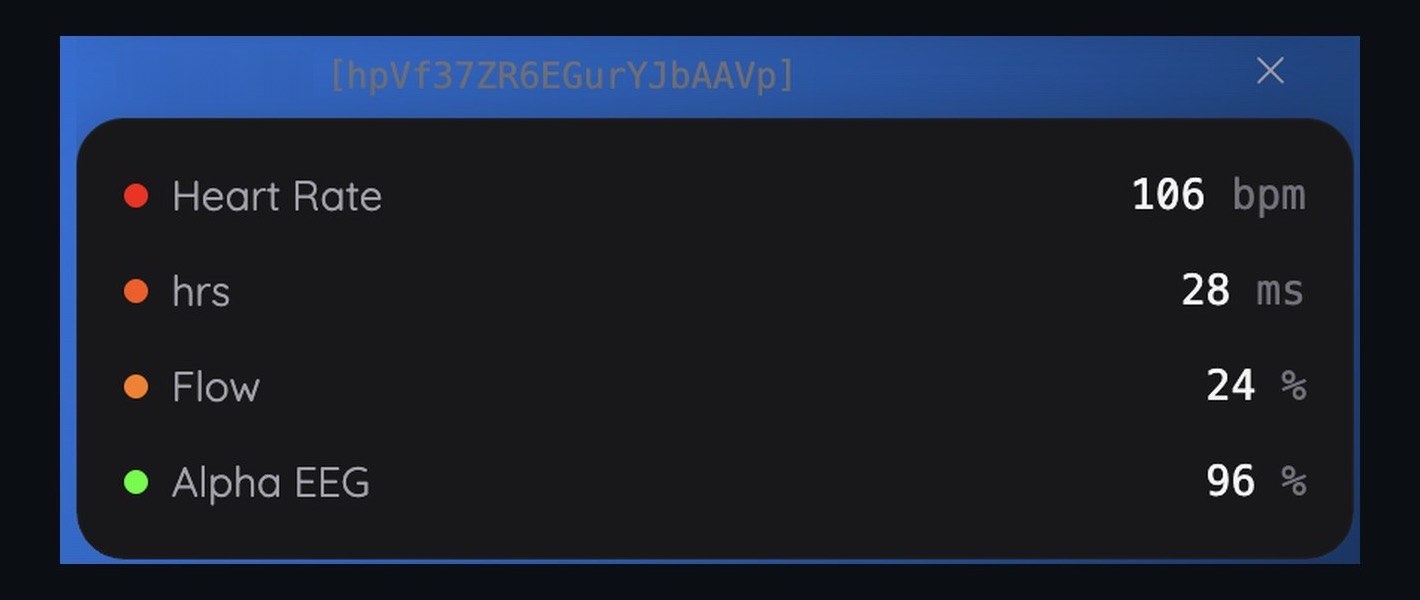
The scenario's event log travels the other way, so the biometric system's own recording carries our timestamps too. Afterwards, “turbulence started here” can go straight next to the heart rate curve.
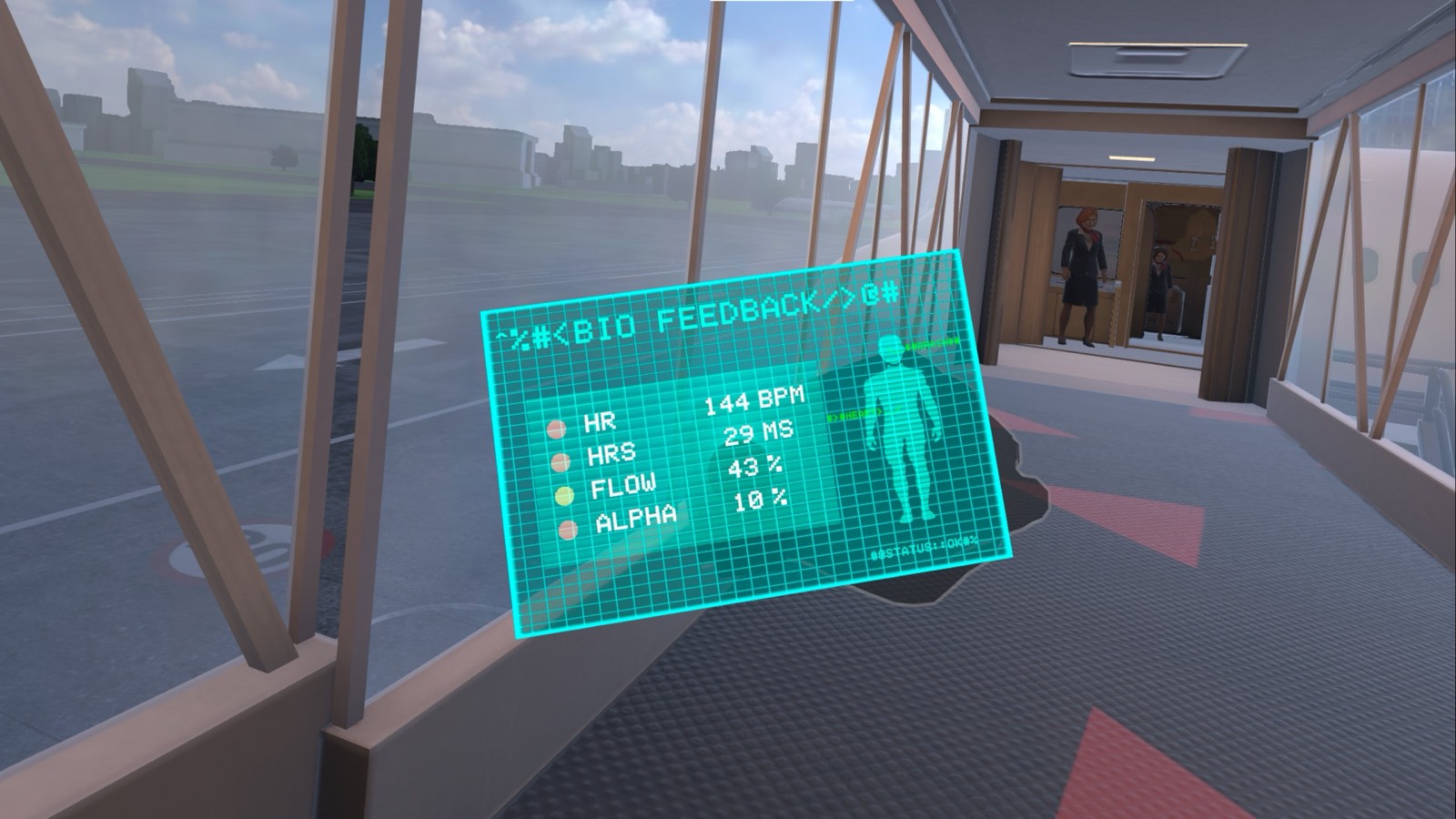
The second destination is rawer. Inside VR the whole integration currently amounts to one thing: a panel that prints those four values, hanging on the jet bridge in the flight scenario. It shows that the data reaches all the way into the scene.
Two things we did not do
We do not store the biometrics. They pass through the server and disappear; nothing lands in the database. Partly this is a category of data we do not want to hold without a reason, and partly we had no reason — the therapist watches the numbers live, and that is exactly what they are for. If we ever want retrospective analysis, it will be a deliberate decision with everything that comes with it, not a side effect of the data having flowed through us anyway.
The numbers drive nothing. The scenario does not turn down turbulence because the pulse went up. There is no threshold, no rule, no automation — on the headset side a single component receives the metrics and all it does is print them. The therapist sees a number and decides, the same way they decide from everything else they see. This is partly by design and partly regulation: the moment software recommends a next step from patient data, it becomes a different class of medical device with a markedly different path to certification.
Where it stands
It is a proof of concept. It ran, the data flowed, we saw it in the dashboard and in the headset. It is not a production feature and we are not pretending it is.
What is missing is the main thing: evidence that biometrics alongside a subjective scale lead to better outcomes. Until that evidence exists, this stays an experiment. We go on asking in words, and merely lay the measurement alongside.